Our self-sensing cantilevers are robust, making them fit for reliable measurements also in liquid environments. The self-sensing cantilevers can even measure in non-transparent liquids where the optical methods fail — fast, efficient and at nanometer resolution:
In hard-to-reach places
In non-transparent liquids (e.g. diluted blood, milk)
In transparent liquids (e.g. deionized water, buffer solutions)
This can be used in industrial applications as:
A promising tool in nanomedicine
Quality control in food industry
Measurements in blood
In practice
How researchers use it
Example 1: AFM imaging in blood and other turbid liquids
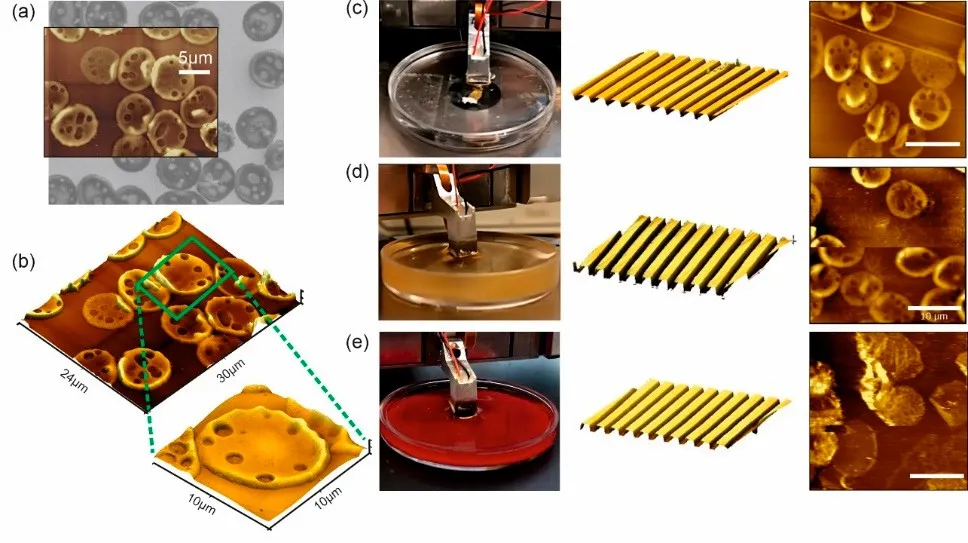
(a, b) Ultra-flat red blood cell ghosts on gold, imaged by SEM and by AFM at the same position. (c to e) The same type of cells imaged in deionized water, blood serum and freshly drawn human blood; for each liquid a calibration grid was measured first. Credit: Leitner et al., Sensors 20, 3715 (2020), CC BY 4.0
The study. Conventional AFMs cannot image in non-transparent fluids such as human blood, because the laser of the optical readout does not reach the cantilever. The Institute of Biophysics at Johannes Kepler University Linz, with GETec Microscopy and SCL-Sensor.Tech, built a laser-free bio-AFM and imaged red blood cell ghosts in deionized water, blood serum and freshly drawn human blood, as well as platelets during blood coagulation.
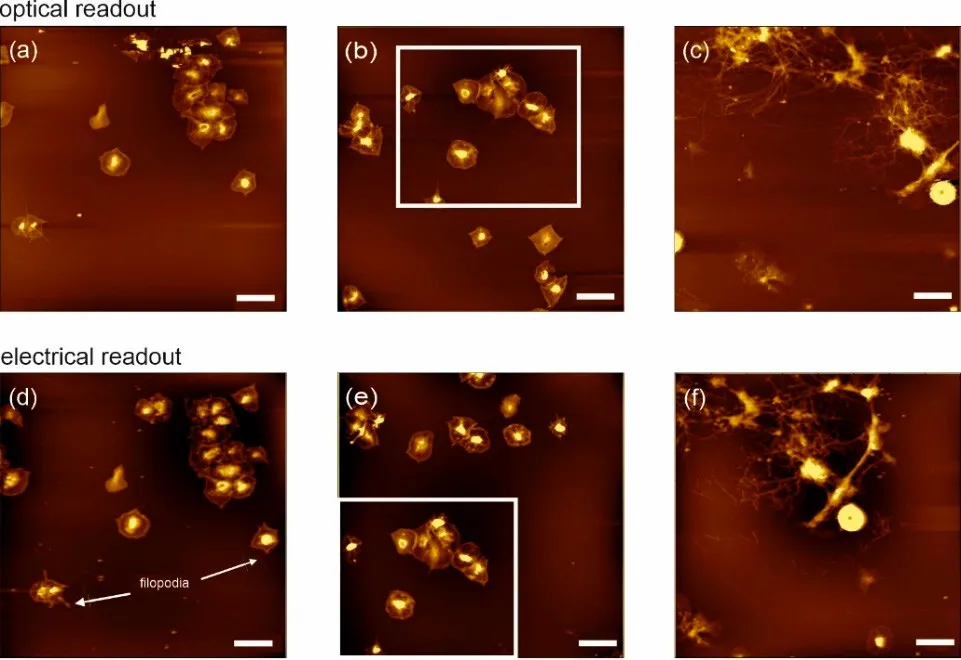
Where our cantilever is used. Our PRSA-L300-F50-Si-PCB self-sensing cantilevers replace both the optical readout and the usual excitation: the piezoresistive bridge measures the deflection and an integrated heating loop drives the oscillation. They were used in two ways, in a conventional optical AFM fitted with a self-sensing nose cone and in an all-electric AFM. In air, optical and self-sensing readout gave equal images of the same platelets.
Platelets imaged in air with optical readout (top row) and with self-sensing readout at the same positions (bottom row). Both give equal results. Scale bars 10 µm. Credit: Leitner et al., Sensors 20, 3715 (2020), CC BY 4.0
M. Leitner et al., Sensors 20, 3715 (2020), doi:10.3390/s20133715. CC BY 4.0.
Example 2: The Trilayer cantilever, built for use in fluid
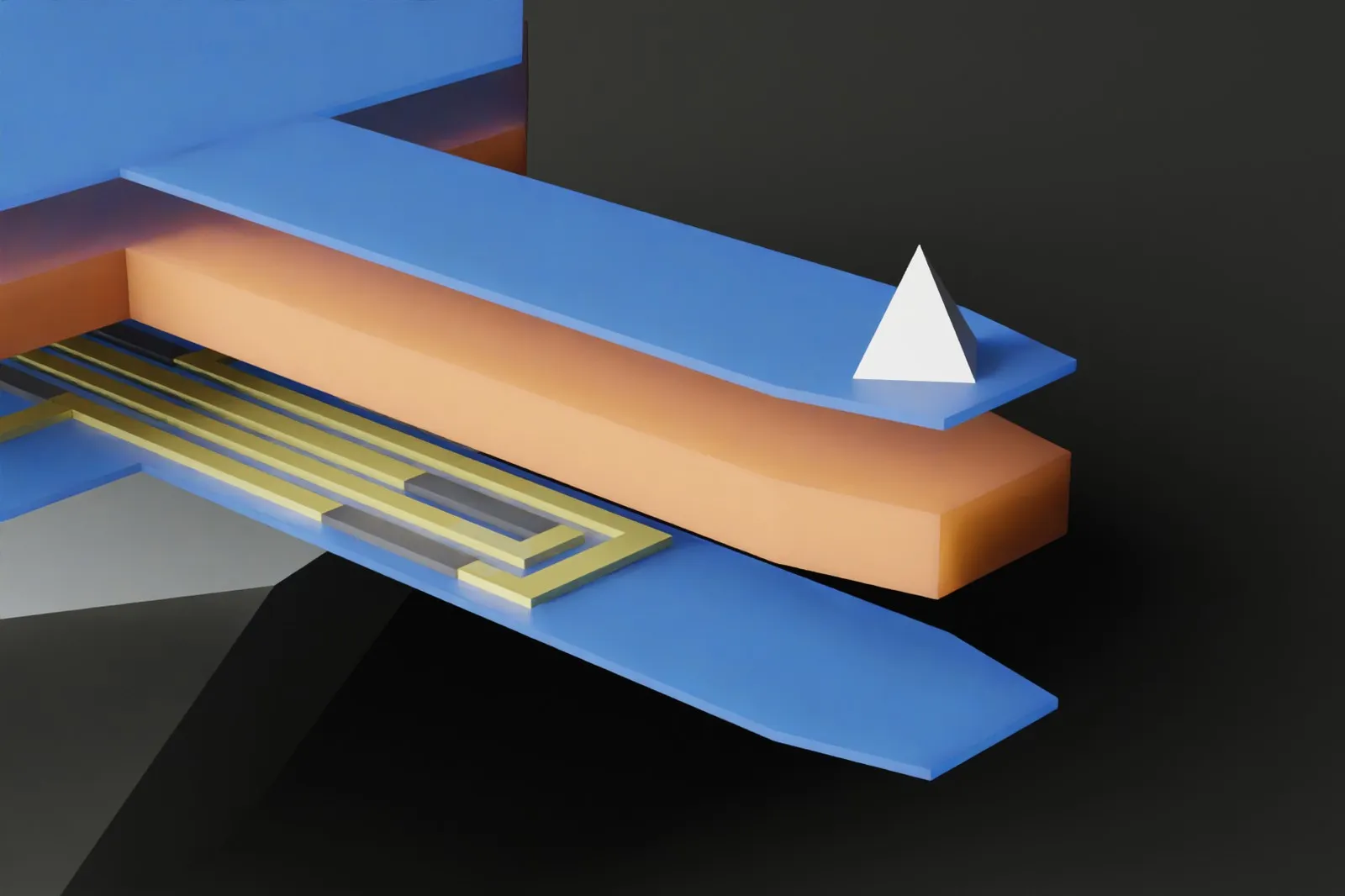
The Trilayer cantilever: a polymer core between two hard layers, with the strain sensors embedded between the layers. Credit: c-sense rendering
The study. EPFL, together with GETec Microscopy, developed a new type of self-sensing cantilever: a soft polymer core between hard ceramic and semiconductor layers, with the strain sensors embedded between the layers. This seals the electronics from the surroundings and lowers the force noise compared with a comparable silicon self-sensing cantilever. The paper demonstrates AFM imaging in vacuum and membrane-based biosensing in fluid.
Where our cantilever is used. This paper describes the technology behind our Trilayer cantilevers. The sealed sensors are the reason the Trilayer line can be used in liquids.
N. Hosseini et al., Nature Electronics 7, 567–575 (2024), doi:10.1038/s41928-024-01195-z. Image: c-sense rendering.