
Self-sensing cantilevers, electronics, and made-to-spec probes.
Silicon and Trilayer self-sensing cantilever probes, electronics for readout and driving them (NanoOne), and customized sensors for non-standard experiments.
Why self-sensing cantilevers?
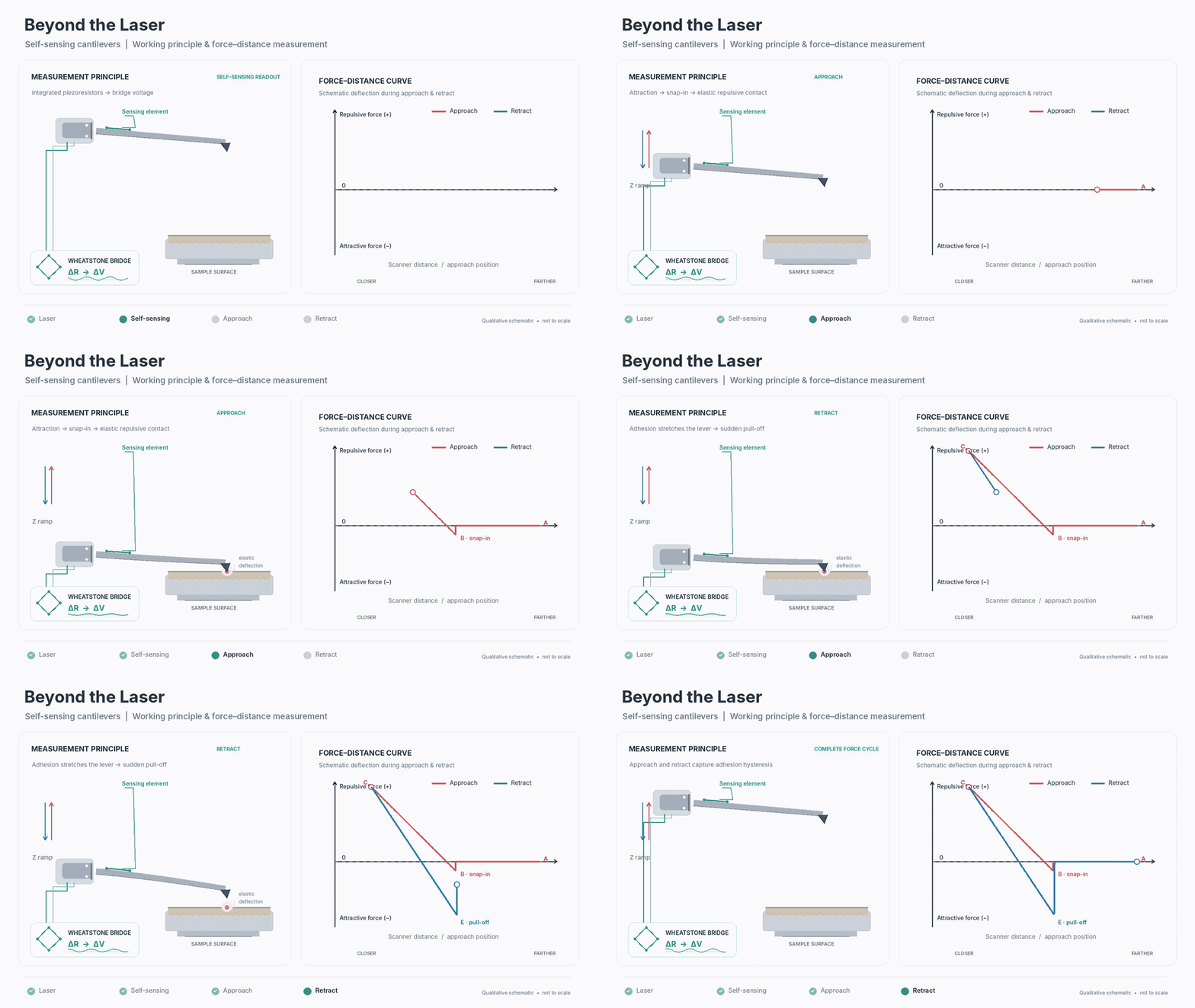
Self-sensing cantilevers rely on an integrated piezoresistive Wheatstone bridge which directly converts the cantilever deflection into an electrical signal. The self-sensing technique works for all applications, but especially where the standard optical readout is in the way or not working.
Self-sensing technology enables an easy and seamless integration with various instruments (e.g. SEM, TEM, but also many other measurement systems). The cantilever chip is bonded onto a small PCB with a small connector for a quick cantilever exchange.
Explore our product lines
Silicon self-sensing Cantilevers
Silicon piezo-resistive self-sensing cantilevers enable completely new applications in the fields of Atomic Force Microscopy (AFM), nanoprobing, torque-magnetometry, or other sensing applications such as gas dynamics and media properties.
Explore Silicon Cantilevers Trilayer probe catalogueTrilayer self-sensing cantilevers
The Trilayer self-sensing cantilevers are composed of an elastic soft polymer core enveloped by two hard thin film layers. This structure enables improved sensitivity and a wider range of applications.
Explore Trilayer Cantilevers Custom & OEMCustomized Sensors
For applications which require non-standard sensor configurations, we offer customized sensors tailor-made for any specific experiment.
Explore Custom Solutions NanoOneNanoOne Starter Kit
The piezoresistive Wheatstone bridge of the self-sensing cantilevers is best read out with a dedicated preamplifier and supplied with a stable voltage.
Explore NanoOneNot sure which probe fits?
Send us your experiment in plain words. We'll route you to a catalogue probe or tell you it needs a custom run.