Beyond the Laser: c-sense at the Millennium Innovation Days 2026
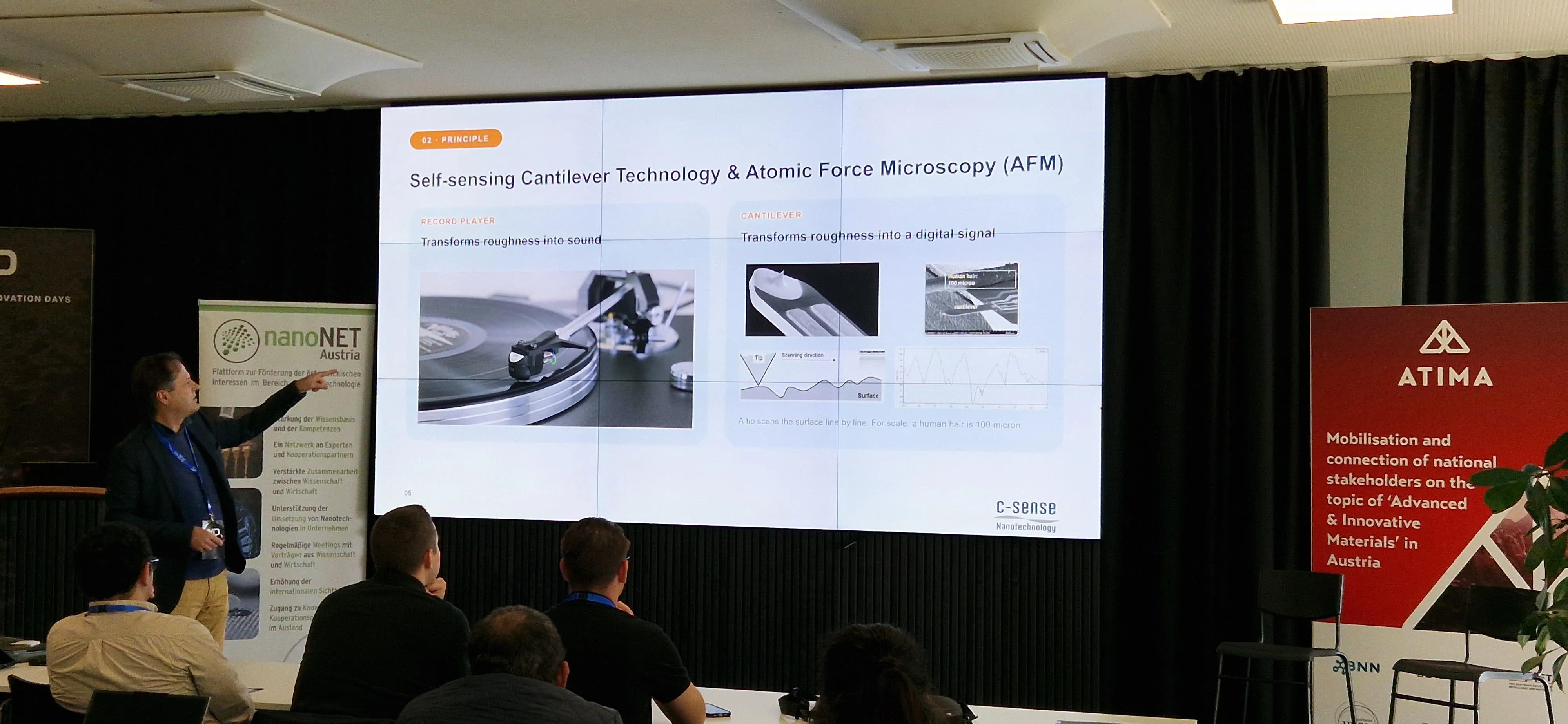
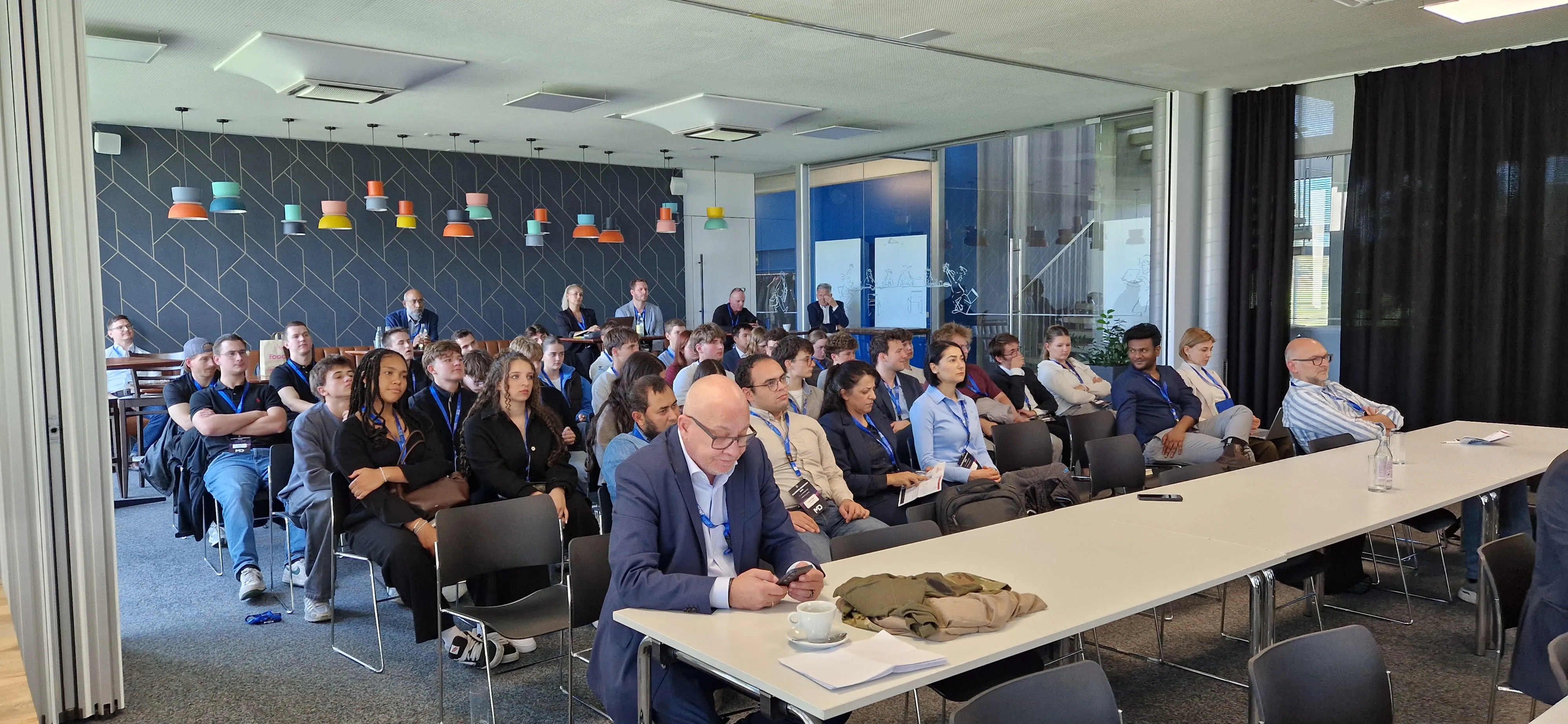
Lustenau, October 2026 – This year’s Millennium Innovation Days in Lustenau brought together researchers, industry and funding agencies from across Austria and beyond to discuss the next generation of advanced materials and manufacturing technologies. c-sense was there for both days, and on 15 October our COO Thomas Fiedler spoke at the 27th nanoNET-Austria Meeting, which took place as part of the event.
No laser. No alignment. More space for your experiment.
Under the title “Beyond the Laser – Self-sensing cantilevers for imaging and probing at the nanoscale”, Thomas showed how our piezoresistive cantilevers measure tip deflection electrically, through an integrated Wheatstone bridge, instead of with an optical laser. This makes atomic force microscopy (AFM) possible in places where conventional systems struggle:
- in turbid and opaque liquids, all the way to imaging red blood cells in freshly drawn, undiluted human blood
- inside the SEM, where AFM and the electron beam look at the same spot at the same time
- in cryostats and strong magnetic fields, for example magnetic force microscopy at 12 Tesla
- on hard-to-reach industrial parts, such as directly on the edge of a razor blade or on the surface of a railway wheel axle
He also introduced our TriLayer cantilevers, developed with our partners at EPFL (Nature Electronics, 2024). They offer four times the force sensitivity of standard silicon cantilevers and scan up to ten times faster, and their encapsulated sensors work reliably in liquids and down to 4 K.
Correlated analysis in one instrument
Another focus of the talk was SNM², our Scanning Nano- & Micromechanical Microscope. It combines AFM, nanoindentation and optical microscopy on a single stage, so the sample never has to move between instruments. A measurement that takes about two hours with the conventional workflow can be done in under 30 minutes, without the risk of contamination or losing track of the point of interest. Thomas also gave an outlook on our ongoing research projects, including PiezotronicNanoProbe, VMag and rotational AFM for quantum optical twisting microscopy.
Inspiring exchange beyond our own field
The talks and conversations in Lustenau gave us plenty of new ideas, from ultrashort-pulse laser processing and low-temperature hard coatings to additive manufacturing at the micro scale. All of these could open new paths toward even more durable tips, new tip materials and special geometries for biomedical applications. The discussions on Austria’s Advanced Materials Roadmap and current funding programmes were also very valuable for our next development projects.
A big thank you to nanoNET-Austria and the organisers of the Millennium Innovation Days for a well-run event, and to everyone who stopped by for a chat.
Curious whether it works on your sample?
A test measurement is the quickest way to find out. Tell us about your sample, its environment and the question you want answered, and we’ll choose the right cantilever and measure it for you.